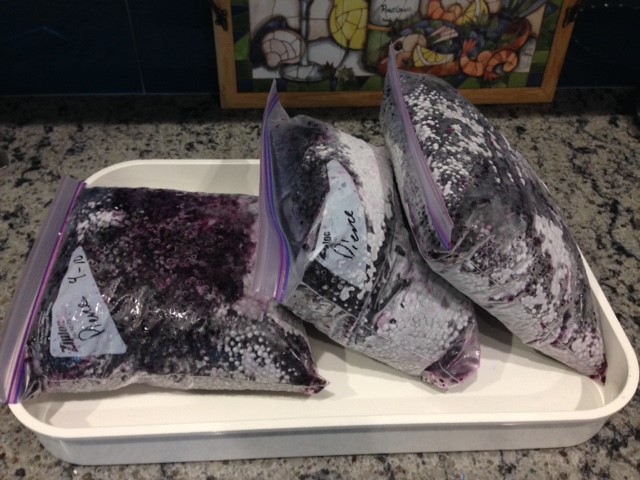
As with the Chambourcin, I did not seek out this wine; rather, it found me. Lisa decided to clean out the lemongrass on the east side of the greenhouse. Naturally, I couldn't let it go to waste. I happened to have picked up a couple of weeks ago a 1 gallon Winexpert Pinot Grigio kit. This kit has 1.6l of PG concentrate, and I imagined that it would work well as a grape base for lemongrass ginger wine.
Ingredients for a 3 gallon batch with extra for topping:
650g fresh lemongrass
1 freshly picked Meyer lemon, juiced and zested
1.6l Winexpert Pinot Grigio concentrate
100g of mild crystalized ginger
44g of strong crystalized ginger
1/2tsp tannin
6g Opti White
3g Booster Blanc
3t pectic enzyme
2kg sugar
2.25tsp citric acid
I prepped the lemongrass stock as I have done before, simmering it twice with the ginger. The stock was drained into the primary and the lemongrass/ginger added to a mesh bag, along with the lemon zest.
The bag was added to the primary, along with the concentrate, and water to 3 gallons. Once cool, the rest of the ingredients were added. pH adjusted from 4.04 to 3.39 with the citric acid. SG went from 1.030 to 1.085 with the 2kg of sugar.
The next day I rehydrated the EC-1118 that came with the kit, and it turned out to be my first case of nonviable yeast. I didn't get any bubbling in the starter like I usually do. I pitched it anyway, and predictably, nothing happened. I suppose the yeast was killed while sitting in the kit somewhere. So I sprinkled K1-V1116 and it took off within a couple of hours. I step-fed Fermaid K and got a nice even ferment and on day 7 at 1.010 I racked it to the carboy.
I will add Kmeta in a couple more days. This wine smelled great during the entire fermentation. It will make a nice drink for summer 2017.
Sunday, December 11, 2016
Sunday, November 27, 2016
Thanksgiving 2016
Adam stayed in Florida with Joy's family for the 2016 Thanksgiving, but Jake and Allie were home. I think we were all hoping for a better November, as both the election and The Game didn't have the desired outcomes. Still, it was great to have everyone together.
The weekend had an inauspicious start.
The sole occupant, not from our family, was unhurt. Not sure the tree will survive however, as the wound is large and deep. It takes a lot of alcohol to total a car without leaving the yard.
On to the food.
The new breakfast dish had apples and pastry topping. Easy and delicious.
Breakfast casserole is tradition.
I finished some limoncello that has been sitting in the closet for a long time. Vanilla is the secret ingredient.
For the first time, we smoked our turkey. The turkey was injected, and thus the big controversy was over whether we should wet brine it starting the day before. In the end, I gave it a 12 hour soak in a diluted wet brine, then smoked it for 6.5 hours around 275F.
It was good, but not that smoky. All of the online sources say the perfect smoking turkey is 12# and we used a 20# bird. So maybe next time we'll try a little smaller bird.
We drank 2015 Elderberry-Blackberry with dinner and while nobody commented on the wine, the bottle was emptied, so I think that is a favorable review.
Before the weather turned on Sunday, Jake and I got some outside work done. We did some fence repairs, adding a fifth board where the cattle are still pushing under the fence.
Then we rented yet another great tool, a T-post driver, and went to work in the vineyard.
With this tool, the in-line T-posts went up in under 2 hours.
The cattle watering trough is gone, replaced by a hydrant. We're almost ready for grapes. In April we're getting 36 Norton and 36 Vidal Blanc, for 2 rows of each. I'm also trying Frontenac, Marechal Foch, Chambourcin, Traminette, and grafted Chardonel.
On the winemaking front, MLF of the Chambourcin and the Syrah was more or less complete 2 weeks ago.
Today we hit both batches with Kmeta and racked off of the oak. Naturally, we sampled both. The Chambourcin has a deep color, medium body, firm tannins; it tastes of dark berries with a nice long finish. The Syrah is, oddly, light in color and body; tannins are soft, and it is quite fruit forward jammy. While it is lighter than I was aiming for, Lisa will love this wine. Jake too! Happy Thanksgiving!
Labels:
2016,
cattle,
chambourcin,
limoncello,
MLF,
Syrah,
T-posts,
Thanksgiving,
vineyard
Saturday, November 12, 2016
2016 Wines - Chapter 9 - Elderberry
I'm only making one 3 gallon batch of straight elderberry wine this year. The rest will be either cofermented with other fruit or used in experimental rosé wines. Nothing new here except for a new yeast. The Pasteur Red proved to be a little troublesome.
We started with 15# of elderberries, thawed.
The berries were simmered in 10.5 qt of water. When the berries were thawed, but not yet too hot, I hand crushed them in the pot.
Initial SG was 1.058. Roughly 6.5# of sugar later it was 1.090. The pH started at 4.60. Although I initially used less acid than last year, I overshot the pH and drove it down to 3.29. I don't like this wine that sharp, so I added 2t calcium carbonate to bring it back to 3.53. Opti Red, Booster Rouge, and pectic enzyme were added, then I covered the surface with plastic wrap and put the bucket in the fridge for a 3 day cold maceration.
After 3 days I warmed it up and pitched a starter of Pasteur Red. I step fed as usual and removed the skins and seeds on fermentation day 4.
Now normally I don't have any trouble moving this wine right through the primary fermentation. And I understood Pasteur Red to be a strong fermenter, with no unusual H2S tendencies or nutrient needs. But this wine stalled around 1.020. Around day 5 it got a slight off odor. I added another pinch of Fermaid K and warmed it up a bit, and that did the trick. The odor cleared up, and at 1.004 I racked it to secondary. Three days after that I racked it off the gross lees.
We started with 15# of elderberries, thawed.
The berries were simmered in 10.5 qt of water. When the berries were thawed, but not yet too hot, I hand crushed them in the pot.
Initial SG was 1.058. Roughly 6.5# of sugar later it was 1.090. The pH started at 4.60. Although I initially used less acid than last year, I overshot the pH and drove it down to 3.29. I don't like this wine that sharp, so I added 2t calcium carbonate to bring it back to 3.53. Opti Red, Booster Rouge, and pectic enzyme were added, then I covered the surface with plastic wrap and put the bucket in the fridge for a 3 day cold maceration.
After 3 days I warmed it up and pitched a starter of Pasteur Red. I step fed as usual and removed the skins and seeds on fermentation day 4.
Now normally I don't have any trouble moving this wine right through the primary fermentation. And I understood Pasteur Red to be a strong fermenter, with no unusual H2S tendencies or nutrient needs. But this wine stalled around 1.020. Around day 5 it got a slight off odor. I added another pinch of Fermaid K and warmed it up a bit, and that did the trick. The odor cleared up, and at 1.004 I racked it to secondary. Three days after that I racked it off the gross lees.
Sunday, October 30, 2016
Putting them to Bed
Lisa was in Florida for a weekend with her mom and sister, and call was kind to me.
The back porch project took another step forward. We removed the railing in the center of the porch and I'm removing a section of concrete to make the center bed more balanced. I cut the concrete last weekend but it did not yield to a sledgehammer. I rented a jackhammer to finish removing the concrete, and it worked like a charm.
I dug out the concrete and put up the two white boards I had. I'm short by 6' 8" so we can't close the book on the project quite yet.
I put the hydrangeas to bed. The last few years I've quit putting up chicken wire baskets in favor of simply a pile of limbs to trap the oak leaves.
The back porch project took another step forward. We removed the railing in the center of the porch and I'm removing a section of concrete to make the center bed more balanced. I cut the concrete last weekend but it did not yield to a sledgehammer. I rented a jackhammer to finish removing the concrete, and it worked like a charm.
I dug out the concrete and put up the two white boards I had. I'm short by 6' 8" so we can't close the book on the project quite yet.
I put the hydrangeas to bed. The last few years I've quit putting up chicken wire baskets in favor of simply a pile of limbs to trap the oak leaves.
![]() |
| Those piles of limbs and leaves are hiding the hydrangeas |
I can't recall ever getting the plants into the greenhouse this late, the second to last day of October. Jake helped me with the plastic a couple of weeks ago when he was home. The plants which spent the summer inside the greenhouse look great. The plants which have been outside look a little rough. Without the bananas, there was room for everything. I recorded a little tour.
Monday, October 24, 2016
2016 Wines - Chapter 8 - Blueberry Rosé
The inspiration for this Blueberry Rosé came from a single comment in a wine blog post. We collected plenty of blueberries from Danamay Farm and at a U-pick farm at the Chalet in Michigan. The berries were frozen, then thawed and directly pressed. The color was nice and dark.
We added half of a can, 24 ounces, of Alexander's Sauvignon Blanc concentrate, along with Booster Blanc, Opti White, and pectic enzyme. The pH was very low at 2.64. Just under 2kg sugar brought the SG to 1.090 and 7t calcium carbonate brought the pH to 3.29. K1-V1116 was rehydrated and pitched. It turned out to be a very slow ferment. I step fed the ferment, kept it cool at first, but finally had to warm it up a little bit to get the specific gravity moving. On day 8 the SG was 1.012 and I racked it to carboy.
This wine has a nice color and nice aroma for this stage of the game. If nothing else, it will be a unique country wine.
We added half of a can, 24 ounces, of Alexander's Sauvignon Blanc concentrate, along with Booster Blanc, Opti White, and pectic enzyme. The pH was very low at 2.64. Just under 2kg sugar brought the SG to 1.090 and 7t calcium carbonate brought the pH to 3.29. K1-V1116 was rehydrated and pitched. It turned out to be a very slow ferment. I step fed the ferment, kept it cool at first, but finally had to warm it up a little bit to get the specific gravity moving. On day 8 the SG was 1.012 and I racked it to carboy.
This wine has a nice color and nice aroma for this stage of the game. If nothing else, it will be a unique country wine.
Minor Harvest
We had a minor harvest at the Pierce Ranch over the past couple of weeks. I cut down the bananas because we need the room and they are too slow to produce. There was one bunch of Dwarf Red left and I cut it down and slowly let it ripen in the garage. We couldn't eat them all before they were fully ripe, so I froze the remainder and we'll use these in wine.
I grew the biggest sugar apple of my career. The rest of the family didn't like it that much so I ended up eating it all.
Finally, after about 10 years, we have blackhaws. They are reasonably sweet, mostly seed, but with a dark brown flesh which reminds me of a date or dried fig. The blackhaws are going into an Estate Quadberry Wine, along with elderberries, blackberries, and haskaps.
![]() |
| Ready for the freezer |
Finally, after about 10 years, we have blackhaws. They are reasonably sweet, mostly seed, but with a dark brown flesh which reminds me of a date or dried fig. The blackhaws are going into an Estate Quadberry Wine, along with elderberries, blackberries, and haskaps.
Sunday, October 23, 2016
2016 Wines - Chapter 7 - Lemongrass Mint
With time, the 2015 Lemongrass Mint wine improved quite a lot. It was perhaps a bit heavy on the mint, but still a very drinkable white wine. Back in May, the mint and lemongrass were abundant, but I wasn't ready to make the wine. So I picked a 3 gallon batch worth, simmered the stock, and put it in the freezer.
Since I was splitting up a can of grape concentrate, I thawed out the stock and started this wine. The stock had 650g lemongrass and 2qt mint leaves. To this I added 24oz Sauv Blanc concentrate, 2.35kg sugar, citric and tartaric acids, Opti White, and Booster Blanc. Looks yummy.
K1-V1116 was the chosen yeast. I'm not sure why, but this was kind of a slow ferment. Maybe it was the fact that I rehydrated the yeast without any must. I kept the temp down to start, and when I let the temp come back up it never really took off. But it steadily worked down to 1.009 on day 7. Because of the slightest hint of an off odor, I splash racked it to the carboy.
Since I was splitting up a can of grape concentrate, I thawed out the stock and started this wine. The stock had 650g lemongrass and 2qt mint leaves. To this I added 24oz Sauv Blanc concentrate, 2.35kg sugar, citric and tartaric acids, Opti White, and Booster Blanc. Looks yummy.
K1-V1116 was the chosen yeast. I'm not sure why, but this was kind of a slow ferment. Maybe it was the fact that I rehydrated the yeast without any must. I kept the temp down to start, and when I let the temp come back up it never really took off. But it steadily worked down to 1.009 on day 7. Because of the slightest hint of an off odor, I splash racked it to the carboy.
Subscribe to:
Posts (Atom)