Showing posts with label chambourcin. Show all posts

Sunday, February 13, 2022

2021 Wines - Chapter 5 - Chambourcin

 The 2020 Chambourcin was probably my best red wine to date. It has good flavor and great color retention. It may be a little bit over-oaked, but I expect it to age fairly well.

So the same approach was taken to the limited 2021 crop. The vines have crown gall and so I only have 3-4 left. Those that are left are heavy producers. Picked 9/22, at 1.080, TA 12, pH 2.86. I crushed and destemmed 9/24, then adjusted with 1T calcium carbonate to pH 3.14 and 500g sugar to 1.090. Opti Red/Booster Blanc/Avante/VP41 coinnoculation. I pressed 5 gallons on 9/29. By 10/23 the test strips read zero malic. I let it go another few weeks before SO2 to be safe. 

I've not decided whether to barrel this wine just yet. It's just aging quietly. My "hands off" winemaking approach is either wisdom or laziness. 

Saturday, September 4, 2021

Summer Summary

It's been a busy summer. The COVID dominos fall every which way. But it is time to post some happenings because harvest is here and the wine is already being made. 


We like to see one new fruit every year and this year it is Pitomba (Eugenia luschnathiana). The fruit is the size of a cherry, texture of an apricot, but aromatic and moderately sweet. Hoping for more than one next year. 

Just before Jake's graduation from medical school we hosted him and two friends at the chalet. We went out on the big lake and brought back a decent haul of fish. I've never been a fan of lake trout frozen, then thawed and cooked in the usual way but I found a terrific smoked lake trout recipe which is delicious. 


The greenhouse is at least half empty and production has been variable. We had a good crop of jaboticabas, but the dragon fruit has disappointed. We did get a couple of softball sized dragon fruit that made a delicious dragon fruit salsa. 


In the vineyard, I replanted 5 Frontenac gris, 10 Itasca, and 10 LaCrescent. From the 2020 vintage, the Chambourcin is terrific, by far the best dry red grape wine I've ever made. It was eye opening for me because I almost didn't pick the fruit. I let it hang a long time, long enough that no adjustments to the must were needed. It seems that letting the fruit hang is, well, kind of important. That lesson has been remembered this year, as you will later see. 


Lisa got me a drone for my birthday.


We took the drone to the chalet for Sharon and Bob's 60th anniversary party 


Itasca, Foch, and Frontenac are out of the vineyard and so far, no adjustments needed on any of them. Vidal will start coming out tomorrow. 

Sunday, December 13, 2020

Winter Wine Work

One of the most pleasant winemaking surprises so far has been the 2019 Frontenac. I had low expectations for this wine. Previous harvests have shown Frontenac to be color unstable and the Frontenac rosé from 2018 is bad enough I've got it in the dump pile. I put 4 gallons of 2019 Frontenac red wine in a barrel last February and have more or less kept it topped up. Four months ago I was ready to dump this wine as well - it was not color-stable, it was thin, and I was concerned it might be oxidized. Fast forward to today, and this wine is pretty darn good. Color somehow is improved and taste-wise it has smoothed out very nicely. I needed the barrel for 2020 wines, so I just went ahead and bottled 2 cases today. 


Additionally, I racked another 7 gallons of Vidal after a month of cold stabilization. I continue to keep separate 4 different batches of the enormous harvest. The last 5 gallons of "less ripe" Vidal went into the fridge to cold stabilize today. Chambourcin went into a 15l barrel with just under 5 gallons left. The plan there is 6 months of barrel aging for each half of the batch. The 2020 Frontenac went in the other 15l barrel. The Foch will go into the 10l barrel once it seals up.

The basement has been a disaster for some time, and we finally got around to cleaning it up. This meant assembling a wine rack. It doesn't hold every bottle but holds some of everything we drink. Lisa got some nice dry erase bottle labels.


2020 Wines - Chapter 6 - Chambourcin

It is with some sadness that we're making this batch of wine. We had high hopes for Norton and Chambourcin in the vineyard, but both varietals have been decimated with crown gall and I'm not optimistic that we'll get fruit again next year. We took about 120# of Chambourcin this year and we'll end up with about 9 gallons from it. 

My record-keeping has been terrible with this batch. I wrote everything down but I lost my notes, thus the late post. I do remember the the starting numbers were great. I didn't adjust pH and made minimal adjustment to sugar - or maybe it was the other way around, minimal pH adjustment, no sugar adjustment. Anyway, either way, these grapes came in better than any others I've grown. 71B to work down the malic, and VP41 for the MLB, co-inoculated. I pressed it off into 3 3gallon carboys plus almost another gallon. After a couple of days racked off gross lees and added 7 oak cubes per gallon to finish up. Great color on this wine, hopes are high. 


Tuesday, September 15, 2020

Harvest Day

Days actually. I picked 120# of Chambourcin by myself on Thursday. Then on Sunday we crushed the Chambourcin and picked, crushed, and pressed 400# of Vidal.

Chambourcin

That's about half

Big clusters


Lisa happily pressed all of it

Crush pad


Sunday, September 29, 2019

Restful Weekends

The harvest is over. I have fruit in the freezer for a few more wines - passion fruit, acerola, pawpaw, jaboticaba - but these will be small, mostly one gallon batches. We're going to let it cool off a bit more before kicking those wines off.

The Foch and Frontenac are holding their color so far and tasting very good if not almost a little bit too fruit forward. I was concerned about the acid, but the malolactic finished in record time and the pH readings look decent at 3.57-3.60. They've received their KMS doses with 100% adjustments. I have two 5-gallon barrels on the way for aging this wine. Hopefully this will concentrate them and add some complexity.


There is significant amount of crown gall in the vineyard, affecting mainly the Chambourcin and particularly the Norton. I'm seriously considering removing all but 1/2 row of Norton and replanting Arandell and Petite Pearl. The Missouri State Grape has proven very disappointing.


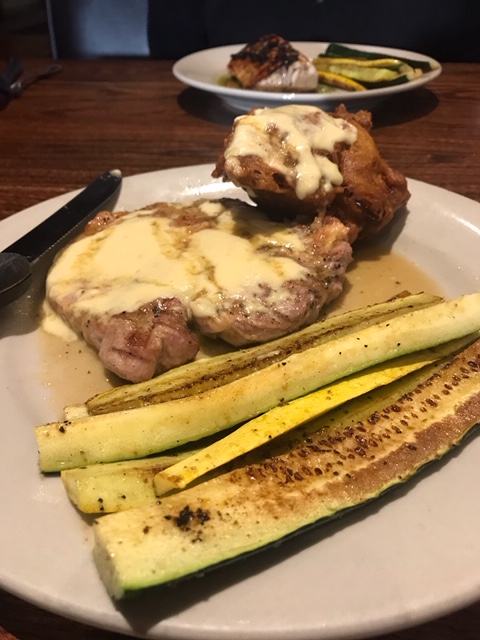
We didn't aggressively pursue the pawpaws this year, instead leaving some for the critters. But Garry texted me looking for some ingredients for specials, and we sent him some pawpaws, lemongrass, and guava. We could not resist going to Bek's to see what Danny did with them, and we were not disappointed.

Pork chop and apple fritter with pawpaw rum sauce
Wahoo with lemongrass and guava gastrique
And we'll leave you with this guy, who's been hanging around the yard for a few weeks. I wonder if he isn't responsible for some of the grape losses, he looks pretty fat and happy.


Sunday, September 22, 2019

2019 Wines - Chapter 7 - Chambourcin Rosé

The first time I made Chambourcin in 2016 I sourced the grapes from our very generous neighbor Bill. I made a red wine which turned out very nicely and took a medal at the KC Cellarmasters Wine Classic. It has aged well and would have probably scored better had I waited another year.

But my Chambourcin this year seemed to want to be a rosé. The numbers lagged in part I think because the vines are young (year 3) and also because, as with the Chardonel, they were overcropped.  Next year, more thinning, more leaf pulling. But this year, rosé it is.

We picked on 9/5. Destemmed, crushed, and pressed, yielding 9.75gal of must. TA 10.8, pH 2/77, SG 1.070. I cold settled for two days, then rewarmed, chaptalized with 1937g sugar to 1.090(est). 20g Opti White, 10g Booster Blanc, 4.5t tannin for color stability, 4.5t pectic enzyme, and 48g KHCO3 to move the pH to 3.05. Then QA 23 with GoFerm and we were winemaking.

I step fed per protocol and added 15g bentonite on day 3. By day 7 it was down to 1.020, so it was moved to carboy. Two days later, just like the Chardonel, it was dry, so it was racked and sulfited.

This is Lisa's 2019 rosé. Fingers crossed!


Sunday, September 1, 2019

Critter Battles

After getting control of fungal issues with a good spray program, I'm now battling two new foes. One is a micro-critter: crown gall has affected many of the Norton and some of the other vines. And the macro-critters seem to find my grapes just as soon as the pH is above pucker. The netting we used this year seems too fragile and I've found holes where the birds or raccoons or possums got in and out. My pick decisions are driven more by how many grapes I have left after the macro-critters than any numbers.

Speaking of numbers...

17-Aug 24-Aug 31-Aug
Brix pH Brix pH Brix pH
Traminette 18 2.76
Frontenac 18 2.66 21 2.97
Vidal 17 2.47 16 2.8 18.2 2.97
Chardonel 15.5 2.44 15 2.66 15 2.74
Chambourcin 13 2.37 13 2.45 14 2.76

I picked the Traminette August 29th and it was a good thing, because I got only 25# and by Aug 31st, despite netting, there was nothing left. The Foch was disappearing at a rate of 10%/day, so I picked it on August 17th at 3.09 and 18.4.  Not ideal. Today the only fruit left hanging is Chardonel, Chambourcin, and a little Norton. Next year we're planning on using the cleverly-named Aircrow.


Sunday, July 21, 2019

Fruit is Coming!


Normally by this time of the summer we are dragging hose and just trying to keep enough water on plants to keep them alive. But so far this year we've stayed wet enough to keep plants looking good and rain barrels in the greenhouse topped up. Growing degree days started accumulating late and despite some really warm temps over the past week, haven't really caught up too much. We're at 1842 since April 16 (average bud break). Also, climate change:


Despite two trips out of town, we largely stayed ahead of the beetle damage so far. We have veraison on Foch and Frontenac, but not Chambourcin:


Speaking of trips, we spent a few days at the Chalet. Bob and Sharon visited, and the weather and company was great.


Upon our return, we had water issues in the greenhouse. The point of failure with my demand pump is the pressure switch. The diagnosis was easy, as this has happened before. Feeling clever, I ordered not one, but three replacement switches. I didn't feel that clever when, after receiving my shipment, I found 2 more extra switches from my order the last time it failed. 


The GFCI outlet the pump uses also failed. In the process of fixing that, I fixed a stripped screw hole in the cover, making it watertight for the first time in a couple of years. The repairs were more satisfying that one would imagine.


This time of year lots of stuff fruits. Not only are grapes coming on, but we've finally got enough jaboticaba for a batch of wine. 


First time ever for a Second crop of Grumichama

Lemondrop Mangosteen

Dragonfruit
Not pictured are blackberries, because I'm embarrassed by the fact that the patch is completely overgrown. More pawpaws again this year, but I suspect it will be another month before they are ripe. 

Some of the Nortons are still struggling but we haven't lost any more vines. And in some really exciting news, we have about 5 of the cuttings take root.


Lisa and I had to work all week, but Allie and Joe were here and got some work done as well. We really enjoyed the visit, hope they did too!


Saturday, February 3, 2018

Better Today than Yesterday, Better Tomorrow than Today

This week the results came in for the Kansas City Cellarmasters Wine 2018 Classic. I entered 9 wines this year - only $10 entry fee, and I really wanted some feedback on all of of my 2016 wines. Also, some folks say these wine competitions are a bit random, so more entries gives a better shot at a medal.

In the past I've medaled at about a 50% rate. I guess I'm getting better, because this year I medaled with 7 of the 9 entries. I won second in class in two categories, worth $40 in gift certificates at St. Louis Wine and Beermaking. Hopefully I can put that toward grapes! In no particular order...

Syrah/Elderberry blend, a 50/50 blend, not surprisingly scored just out of medal range at 12.67. Judges felt that the elderberry overpowers this wine and I completely agree. You have to close your eyes and pretend you are drinking a fruity elderberry.

Syrah/elder/blackberry, 70/15/15 blend, scored better at 13.83 for a bronze. Still probably too much elderberry, and some judges felt it could use some sugar. This need for more residual sugar shows up a lot in my feedback, and I'm beginning to think this is just a personal preference we have for drier wines. These dry wines suffer in competition due to the Pepsi Paradox.  I've put at least one bottle away for long term aging, I think this wine will age well.

The 2016 passion fruit wine was interesting because we opened a bottle at Christmas (fulfilling a vow to open one bottle of each wine just before the submission date, just for quality control purposes). I thought it was excellent. Beth and Lisa noted an off odor of funk or onions which, try as I might, I couldn't pick up. Well the judges missed it too, and this wine came in at 15.33, my highest score, worth a silver medal.

Blueberry rosé scored just in medal range at 13.00, but that score was worth second in the category, so was enough for one of the $20 gift certificates. I'm not particularly proud of this wine - I bottled it early, but missed on the acid. So I dumped it back into the carboy, treated it with KHCO3, then rebottled. It was better, but I thought the KHCO3 left it a little out of balance. The judges thought it was still too acidic with too little blueberry. Fair enough. I recognized the mistakes I made and adjusted with the 2017 version of this wine.

The wine with perhaps the greatest discrepancy between comments and score was the 2016 elderberry. I got three judging sheets back, and the final comments from each were, "Nice balanced fruity wine," "Nice overall wine for its age," and "Very nice wine." So I would have expected a little better than 13.67, bronze medal range. Elderberry tends to age well. I am going to start holding some of these wines for year or two before sending them in.

Chambourcin scored 14.3, worth a bronze. There weren't too many negative comments here either, with one judge noting this wine should age well. I agree. Thank you, Bill Books, for these grapes.

I think the judges at this competition just don't like dry blackberry wine. Seems there is an expectation that blackberry will always be sweet. I went to great lengths to assure that my 2016 blackberry did not suffer from the fatal flaws of the 2015 blackberry. I still only managed a score of 11.67. Comments included "too tart" and "needs some sugar." One judge noted "little blackberry aroma." There is literally nothing but blackberry in this wine. Short of spiking it with flavoring or blackberry brandy, there is no way to cram in more blackberry. Next year I may pull off a 1/2 gallon and sweeten it to 2% RS, just for this competition.

In contrast, everyone lines up behind the 2016 blueberry. This wine scored a silver medal with 15.17. We did bench trials for back-sweetening and wound up using 40g/gal. Comments included another "too tart" along with "needs more blueberry." I made some tweaks to my blueberry this year that might help in this regard.

Finally, the 2016 pinot grigio. This was a California juice bucket. This wine scored 15.17 as well, worth a silver medal and second in the white vinifera category. I've detected intermittently a very slight off odor - one of the four judges picked this up as well. They all liked it well enough however.


Sunday, September 10, 2017

Paybacks and Payoffs

I have not yet decided whether to make pawpaw wine. I'm freezing the pulp as they ripen, and I've got over 4# now which should be enough for a 1 gallon trial. It would be easier if I knew whether it would be any good. Online reviews are scarce and indeterminate. One person paraphrased Jack Keller, calling it "life-changing," but given what Keller wrote I think that is a bit of a stretch. For now I'm content with smoothies.


In the greenhouse I made a discovery that will be meaningful to very few of my friends. We have fruit set on garcinia intermedia. This is most commonly known as Lemon Drop Mangosteen. This garcinia is a seedling from my first PR trip in 2010. It is not the first it has flowered but it is the first time to set fruit. It is hard to contain my excitement.


As a thank-you for the grapes and support, I took the Books some wine. I sent two bottles of their 2016 Chambourcin and one each of the 2016 Blackberry and my 2016 Motley Red blend. Early reviews, based on the text messages, were favorable.